A memorial bench for your pet: where it can go, what it costs and how to plan it
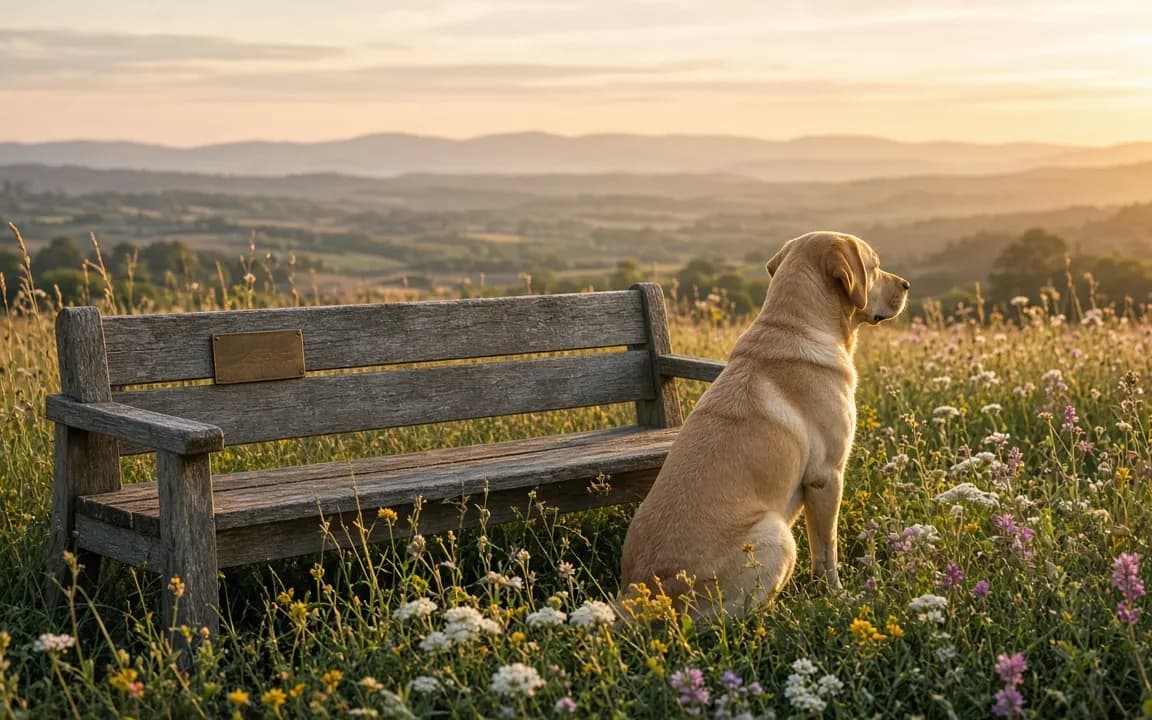
A memorial bench is a seat with your pet's name on it, usually on an engraved plaque or carved into a stone backrest. Most people put one in their own garden, where you decide everything; a park or pet cemetery bench means applying first and following their rules on size, plaque and upkeep.
By the Pet Memorial Stones & Garden Markers editorial team · Updated September 24, 2026 · 6 min read · Sources
- Garden, cemetery and park options compared
- Plaque wording that stays readable
- The base, anchoring and upkeep costs people miss
The short answer
Why choose a bench instead of (or as well as) a stone?
A stone marks where your pet is. A bench gives you somewhere to be with them. That difference matters more than people expect: many owners say the hardest part of the first months is the lost routine, the morning walk or the evening spot on the step. A bench turns a few quiet minutes each day into something you do on purpose.
Research on pet loss backs up how much routine counts. In the RSPCA's large pet-loss survey, 72.6%[1] of bereaved owners said they lost their daily routine or sense of purpose. A seat facing the garden, the grave or the view your dog always watched from gives that time a home.
Benches also solve a problem stones can't. If your pet is buried in a flower bed you don't want to walk on, or their ashes are indoors, a bench can sit anywhere you'd naturally pause. Some families pair the two: a flush granite marker at the grave and a bench a few steps away with a small plaque. Our memorial stone services page shows how the two are usually quoted together.
Placement
Where can a pet memorial bench go?
There are three realistic places, and the rules get stricter as you move away from home.
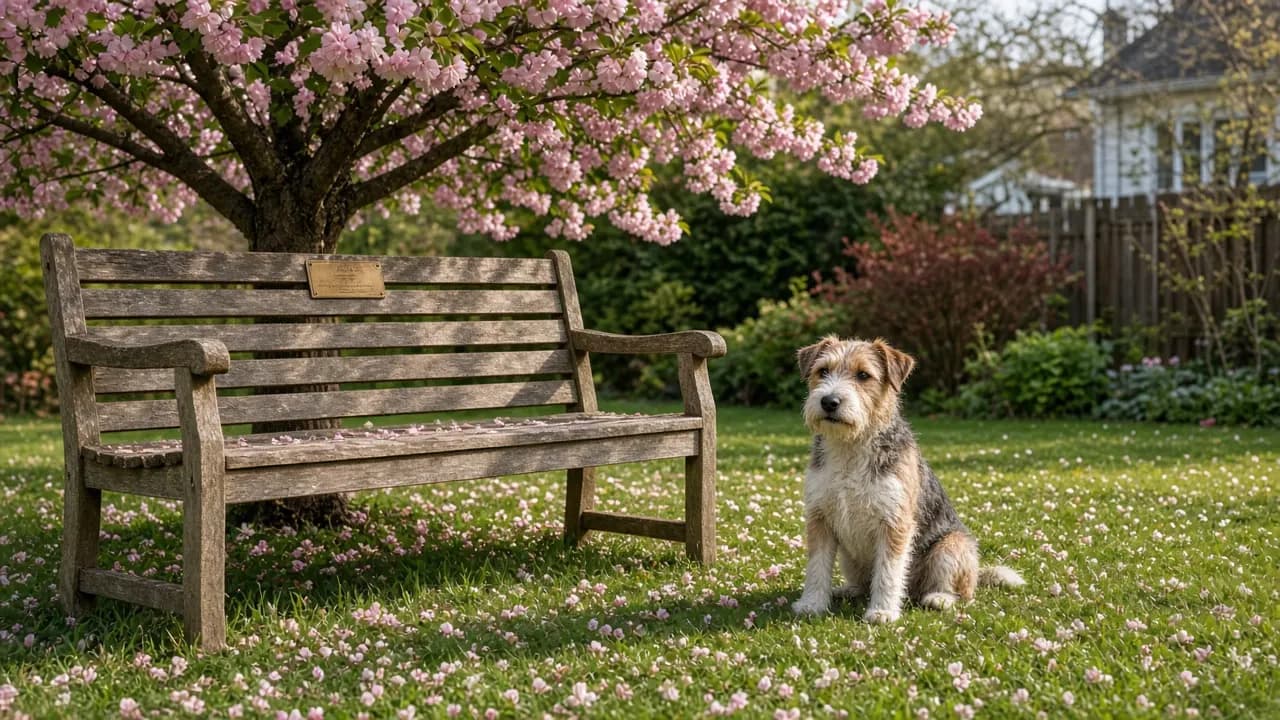
- Your own garden or yard. No permission needed if you own the property. You choose the bench, the plaque and the view. If you rent, ask your landlord in writing first, and pick a freestanding bench you can take when you leave.
- A pet cemetery. Some cemeteries sell bench spots along paths, usually with a fixed design so the grounds look consistent. Expect a setting or installation fee and rules on plaque size. The pet cemetery marker rules guide covers what to ask.
- A public park, trail or dog park. Many towns run dedication programs, but they're written for people, and not all accept a pet's name. Ask the parks department whether pet dedications are allowed, what the fee includes and how many years the bench is kept before it's retired or re-dedicated.
Public programs usually cost more than a garden bench because the fee covers installation, a concrete pad and maintenance for a set term. Ask for the current fee in writing, since it changes and differs widely between councils and cities. A garden bench, by contrast, is mostly the price of the bench and the plaque. Your local page notes regional climate and cemetery points, and the live poll results show how other readers are marking the spot.
Where would your pet's stone go?
Tap an answer to vote and see how others answered. Anonymous.
Choosing the bench
Wood, stone or metal: which bench lasts outdoors?
The bench material decides how much looking after it needs. Here's how the common options compare in a garden that sees rain, sun and frost.
| Material | How it weathers | Upkeep | Good to know |
|---|---|---|---|
| Teak or iroko hardwood | Fades to silver-grey; very rot resistant | Occasional clean; oil only if you want the honey color back | Heavy enough to stay put; plaque screws into the backrest |
| Pine or softwood | Softens and can rot where it touches soil | Stain or seal every year or two | Cheapest; keep the feet on pavers, not grass |
| Granite or stone bench | Barely changes; shrugs off frost | Rinse and soft brush | Very heavy; lettering can be carved straight into the seat or back |
| Cast aluminum or steel | Aluminum doesn't rust; steel will if the coating chips | Touch up chips | Light benches need bolting down in public spaces |
| Recycled plastic lumber | Doesn't rot or splinter | Wash only | Plaques need through-bolts rather than wood screws |
If you want the name cut into stone rather than on a plaque, a granite bench is the most permanent option. The same rules about stone density and lettering depth apply as for a grave marker, and our guide to outdoor stone grade and engraving depth explains what to ask a maker for. For cleaning a stone bench, the National Park Service's grave marker guidance holds: soft brushes, water and nothing harsh.
The words
What should the plaque say, and how big should it be?
Bench plaques are small, usually a few inches tall, and they're read from standing height or while sitting beside them. That favors short wording in large letters. A name, the years and one line is plenty; longer tributes shrink the letters until nobody can read them without bending down.
- "For HAZEL, who sat here first. 2012–2026"
- "MILO's spot. Keep him company."
- "In memory of DUKE, who always claimed the sunniest seat in the whole garden" is long; "DUKE's seat" says the same in two words.
- A name and a small paw print, with nothing else
Engraving is often priced by the character or the line, so short wording also keeps costs down. Headstone engravers commonly charge $8 to $35 per character[2], and some charge a flat $50 to $150 per line[3]. Bench plaques are usually cheaper than cutting stone, but the same logic holds. Our post on what to write on a pet memorial stone has more short lines that fit small spaces.
Free tool
Memorial stone planner
Plan size, material and engraving length so your wording fits the stone.
Installation
How do you set a bench so it stays level for years?
A bench standing straight on a lawn will sink unevenly, rock and trap water under its feet. The fix is simple: give each foot, or the whole bench, a firm base.
- Mark the spot and check the view. Sit on a kitchen chair there at the time of day you'll use it most. Morning sun, evening shade and what you'll be looking at all matter.
- Lay a base. For a garden bench, four large pavers or a small patio of slabs on compacted gravel works well. Heavy stone benches need a concrete pad or a deeper gravel bed.
- Keep it off the grave. Don't place the bench directly over a buried pet. Digging for the base can disturb the grave, and the weight compacts the soil unevenly.
- Anchor if needed. In public spaces, or anywhere a light bench could be lifted, bolt it to the pad with ground anchors.
Cemeteries and parks usually install benches themselves and charge for it. As a reference point, one public cemetery district in Washington State charges $130[4] just to set a pet grave marker, so a bench with a pad will cost more. If you're setting a stone and bench together at home, our step-by-step on how to set a memorial stone in the garden covers the gravel bed in detail. Pads and posts mean digging, so in the US contact 811, the free before-you-dig service, a few days ahead.
Budget
What does a pet memorial bench cost overall?
Because benches range from flat-pack softwood to solid granite, the honest answer is "it depends on the seat". What catches people out is everything around it: the plaque, the base, delivery of something heavy, and any fee to put it somewhere you don't own.
- The bench itself. Get a written price, including delivery. Stone benches often ship by freight on a pallet.
- The plaque or engraving. Priced by size, metal and number of characters.
- The base. Pavers and gravel for a DIY job, or a contractor-poured pad.
- Placement fees for a cemetery or park, plus any upkeep charge.
- Upkeep over time. Oil for hardwood, stain for softwood, nothing much for stone.
Upkeep charges add up where someone else maintains the ground. Hartsdale Pet Cemetery in New York, for example, charges $105 a year[5] for plot care, and its one-time perpetual care fee equals roughly 33 years[6] of annual payments. Whatever you choose, the memorial budget planner lets you put the bench, plaque and stone in one total.
Free tool
Memorial budget planner
Add up cremation, urn, keepsakes and a farewell so the total holds no surprises.
Thinking ahead
What happens to the bench if you move house?
This is where benches beat most stones. A freestanding bench on pavers comes with you in a van, plaque and all, and fits into a new garden on day one. That makes a bench a good choice for renters, or for anyone who suspects they won't stay in the house forever.
Personal touches are what people value most here: 51%[7] of pet owners in one market report said they were interested in personalized memorials. A bench that has traveled with you through two or three homes carries that personal history with it. If your pet's grave stays behind, see our post on moving house with a pet grave for gentle ways to handle it.
A stone tells visitors where your pet is. A bench tells them where you liked to sit together.
When you're ready, send us the details: the spot, the bench style you like and your plaque wording. We'll reply by email with options and prices from makers who deliver to your area.

Reader polls
What would you choose?
Vote anonymously and see how other readers answered. The results are live counts from people who visit this site, so they show real opinions, not a scientific sample.
Where would your pet's stone go?
Tap an answer to vote and see how others answered. Anonymous.
Do you keep more than one memorial for the same pet?
Tap an answer to vote and see how others answered. Anonymous.
What helped you most in the first weeks?
Tap an answer to vote and see how others answered. Anonymous.
Questions people ask
Can I put a memorial bench for my dog in a public park?
Sometimes. Many towns run bench dedication programs, but they're designed for people, and some don't allow pet names or require wording like "in memory of" a person. Ask the parks department whether pet dedications are accepted, what the fee covers, how long the bench is kept and whether the plaque can be replaced if it's damaged.
How long does a wooden memorial bench last outdoors?
A dense hardwood such as teak or iroko can last decades outdoors with little more than cleaning, fading to silver as it ages. Softwood benches last years rather than decades and need staining or sealing every year or two. Keeping the feet on pavers instead of grass is the single biggest thing you can do to slow rot.
Should the bench go directly on my pet's grave?
It's usually better to place the bench a few steps away, facing the grave. Digging or pouring a base over the grave can disturb it, and the bench's weight will compact the soil unevenly so it tilts. A flush stone on the grave and a bench nearby gives you both a marker and a place to sit.
Which plaque material lasts longest outside?
Bronze is the longest-lasting and ages to a soft brown that many people like. Stainless steel stays clean and grey. Brass looks lovely at first but tarnishes unless you polish it, and anodized aluminum can fade in strong sun. Whatever the metal, ask for deep lettering and tamper-resistant fixings.
Can I engrave my pet's name straight into a stone bench?
Yes. Granite benches can have lettering sandblasted into the backrest, seat edge or a panel on the leg, just like a headstone. It's more permanent than a plaque but can't be changed later, so check the spelling carefully and ask the maker for a full-size proof before anything is cut.
Is a memorial bench a good idea if I rent?
It can be one of the easiest memorials for renters, as long as it's freestanding. Set it on loose pavers rather than a concrete pad, ask your landlord before placing it, and it can move with you. A bench also works if your pet's ashes are indoors and you simply want a quiet outdoor spot to think of them.
Keep reading

Stones, markers and benches
Every outdoor memorial option we help you get quoted.

Pet cemetery marker rules
What to check before buying anything for a cemetery plot.

Memorial budget planner
Add the bench, plaque and stone into one total.

Ask for bench quotes
Tell us the spot and wording; we reply by email.
Sources and our estimates
- [1] After losing a pet, 72.6% lost their daily routine or sense of purpose, 69.8% had trouble concentrating and 65.9% had sleep problems. RSPCA — Pet Loss Survey Results, 2026.
- [2] Headstone engravers charge $8–$35 per character; a standard 40–60 character inscription totals $500–$1,200. Memorials.com – Headstone Engraving Cost, 2026.
- [3] Some engravers charge a flat $50–$150 per line of text, depending on stone and provider. Memorials.com – Headstone Engraving Cost, 2026.
- [4] Rainier Cemetery District's pet section sells plots for $150 (small) and $200 (large), including the first burial; a marker-setting fee is $130. Rainier Cemetery District – The Companion Corner, 2026.
- [5] Hartsdale Pet Cemetery in New York charges $105 a year for plot maintenance, or $3,500 one time for perpetual care. VOA News – America's oldest pet cemetery, 2024.
- [6] Hartsdale's one-time perpetual care fee equals about 33 years of its annual maintenance fee. Our estimate: $3,500 / $105 per year. How we calculate.
- [7] Astute Analytica reports 51% of pet owners are interested in personalized memorials and 70% consider memorialization significant. Astute Analytica via GlobeNewswire — Global Pet Preservation Services Market to Hit USD 112.7 Million by 2032 (Apr 2, 2024), 2024.
Get memorial bench and plaque quotes
Tell us what you need and where you are. We'll reply by email with clear options and prices so you can decide in your own time.