A garden memorial your children can visit, help make and feel part of
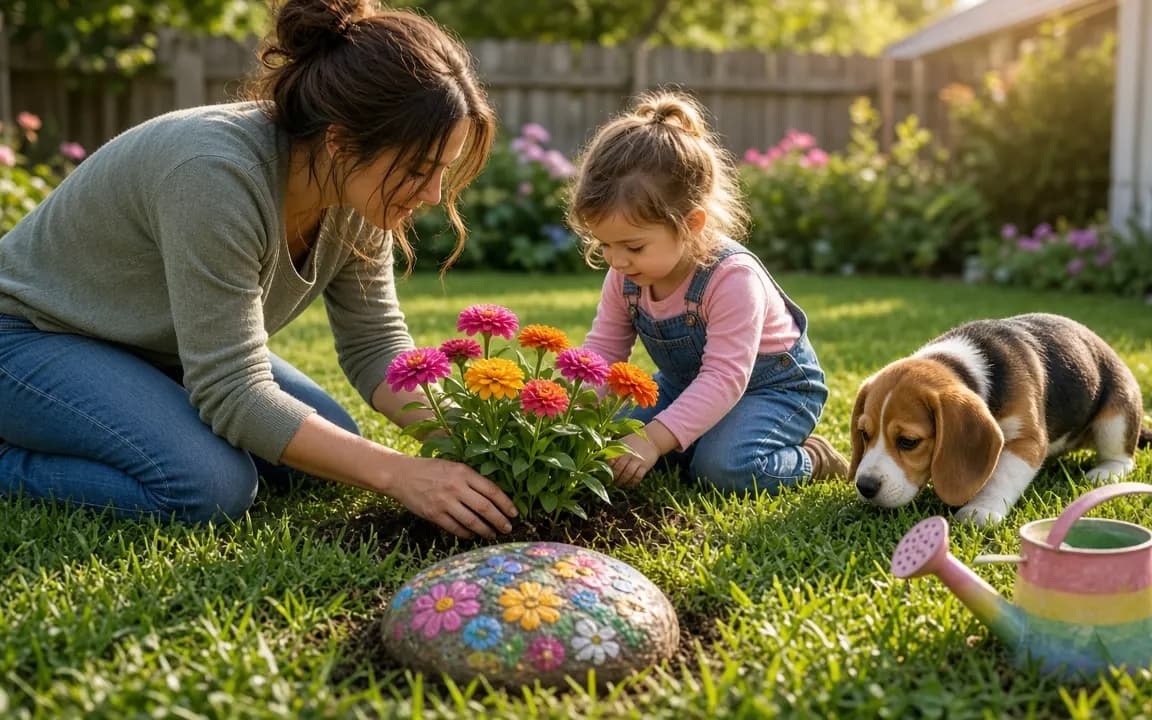
Give children a real job in the memorial, sized to their age: painting a stone, choosing a flower, helping with the words. Keep the spot safe and easy to reach, with a flat stone they can't pull over and plants that won't harm them or other pets.
By the Pet Memorial Stones & Garden Markers editorial team · Updated September 24, 2026 · 5 min read · Sources
- Jobs for toddlers, school-age kids and teens
- Safe stones and plants for a family garden
- Simple words for the first visit to the grave
The short answer
Why involve children in a pet's memorial at all?
For many children, a pet's death is their first experience of loss. Being part of the memorial gives them something concrete to do with feelings that are hard to name. It also tells them their grief counts. Children who are shielded from the burial or left out of decisions often fill the gap with their own, sometimes scarier, ideas.
Parents often feel unsure how to handle it. In a large RSPCA survey, 93.4%[1] of parents said they wanted better guidance on helping children through pet loss. A garden memorial isn't the whole answer, but it's a practical one: a place, a task and a routine that the whole family can share. The same survey found more than half of bereaved owners couldn't find the support they needed; applied to US pet deaths, we estimate that could mean roughly 850,000[2] households a year. For words that suit different ages, the Dougy Center for grieving children and families has resources written for parents.
Pets are family to most households. In the same RSPCA survey, 99.3%[3] of respondents saw their pet as family, a friend or a companion, and around 53%[4] of US households have a dog, while 59%[5] of UK households include an animal companion. So a lot of children will face this at some point, and a lot of parents are working out what to do right now.
Jobs by age
What can children do to help, age by age?
| Age | What they understand | Jobs that fit |
|---|---|---|
| Under 5 | Death is confusing; they may ask when the pet is coming back | Choose a flower, put pebbles around the grave, press a handprint next to a paw print |
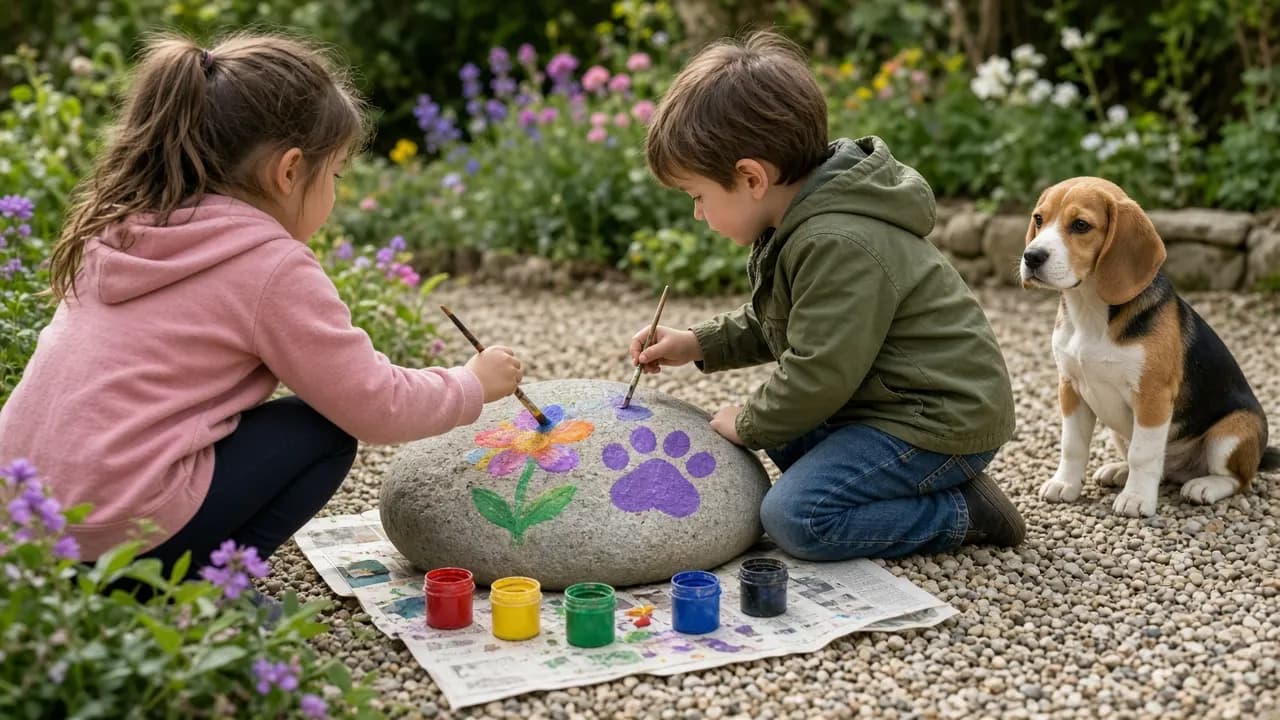
| 5 to 8 | Beginning to grasp that death is permanent | Paint a rock, draw a picture to bury or keep, water a new plant |
| 9 to 12 | Understand fully; may worry about other pets or people dying | Help choose the stone and wording, plan the planting, make a sign for the temporary marker |
| Teenagers | Often grieve deeply but privately | Write the line for the stone, help dig and set it, choose music or a reading for a small ceremony |
Let children opt in rather than assigning jobs. Some want to be very involved; others prefer to watch, or come back to it later. Both are fine. Our post on outdoor rituals while a marker is being planned has more ideas for the first weeks.
Hands-on
How do you make a painted memorial stone that lasts?
A painted stone is the classic family memorial, and with a bit of preparation it can survive a few years outside. Here's what helps:
- Choose a smooth, flat, dense stone, like a river rock the size of a hand or bigger. Wash and dry it well.
- Paint a base coat of outdoor acrylic or patio paint, and let it dry fully.
- Let the children paint the design: the name, a paw print, favorite toys, colors the pet loved. Paint pens help with lettering.
- Seal it with two or three coats of clear outdoor varnish, letting each coat dry.
- Place it at the grave or beside a permanent stone, in a spot that isn't in standing water.
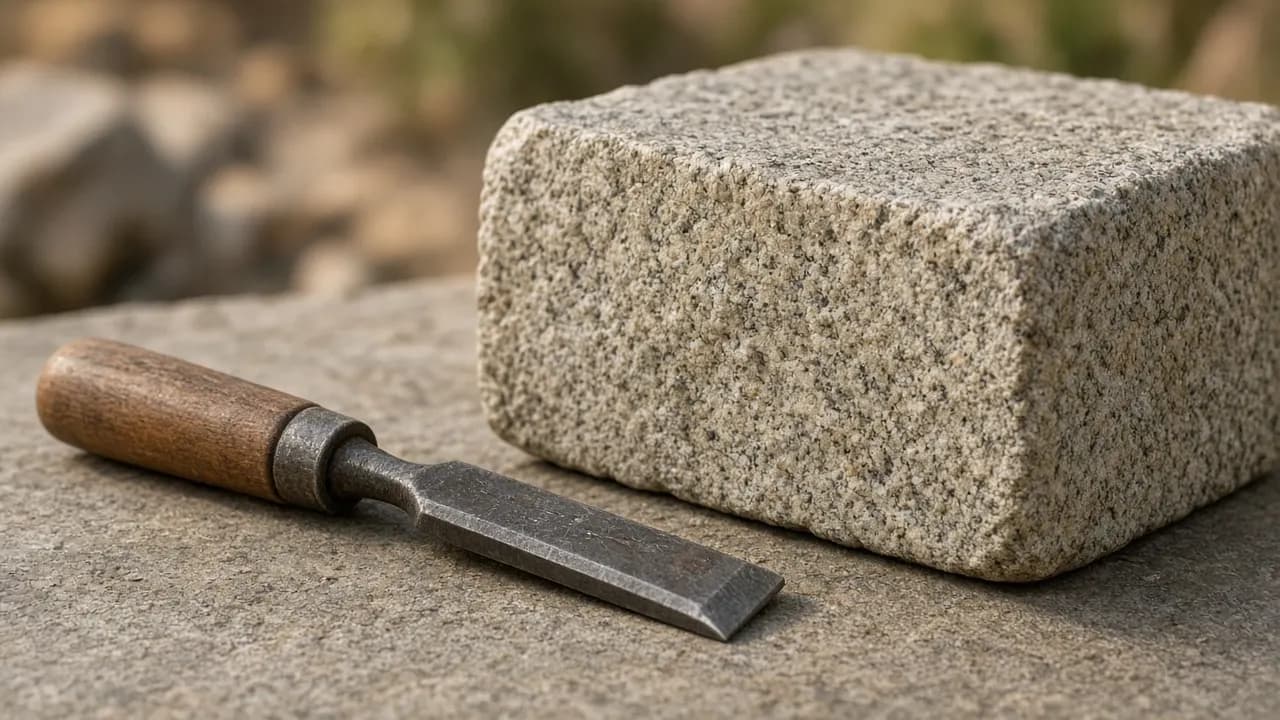
Painted stones fade over time, and that's okay. Some families repaint theirs each year on the pet's birthday, which becomes a small tradition. If you'd like something permanent alongside it, an engraved river rock or granite marker can carry the name for decades; our materials comparison explains the options.
Choosing words
How can children help choose the words on the stone?
Children often come up with the most honest lines. Ask each child what they want people to know about the pet, or what they'd say if they could say one more thing. Write every answer down; one of them may be perfect.
- "He always won at fetch" becomes "CHAMP OF FETCH", which fits on a small stone.
- "She always slept on my bed" becomes "LUNA, my night-time friend".
- A child's drawing of the pet can sometimes be etched or engraved as line art.
Small stones have limited space, so it helps to test ideas together. The memorial stone planner shows how many letters fit on each line, which turns choosing words into a puzzle older children often enjoy. Our post on what to write on a pet memorial stone has more examples. You can also see what other families chose to carve in the live poll results.
Free tool
Memorial stone planner
Plan size, material and engraving length so your wording fits the stone.
What would you engrave besides your pet's name?
Tap an answer to vote and see how others answered. Anonymous.
Safety
What makes a memorial safe for young children to visit?
- Flat or low stones. Upright stones can tip if climbed or pulled. Flush or tilted markers set on a firm base are safest.
- No sharp edges. Choose rounded river rock or ask for eased edges on granite.
- Safe plants. Avoid toxic plants like foxglove, lily of the valley, oleander and yew. Lilies are also dangerous to cats.
- No small loose decorations for toddlers, such as marbles or glass pebbles, which are choking hazards.
- An easy path. Stepping stones or a short gravel path mean children can visit on their own in any weather.
If you're planting a tree, the memorial tree finder suggests options by climate and yard size. Children often like having a tree to measure against themselves each year. Before you plant, check the ASPCA's list of toxic and non-toxic plants, especially if a dog or cat still uses the garden. Your local page has climate notes for your area.
At the grave
What should you say on a child's first visit to the grave?
Use simple, honest words: your pet has died, their body is resting here, and they can't feel pain or cold. Avoid phrases like "put to sleep" or "went away" with young children, since these can cause fear of sleep or confusion about whether the pet will return.
It's also fine to show your own feelings. Children learn that sadness is safe when they see adults cry and then carry on. Grown-ups often hear unhelpful comments too: 34.5%[6] of bereaved owners in the RSPCA survey were told "it's just a pet". Showing children that it's more than that is part of the lesson.
A crooked painted rock placed by a small hand can mean more than any stone you could buy.
When the family is ready for a permanent stone, tell us a bit about your pet and we'll reply by email with options, including stones children can decorate or add to. You can also see every stone and marker type first.

Reader polls
What would you choose?
Vote anonymously and see how other readers answered. The results are live counts from people who visit this site, so they show real opinions, not a scientific sample.
What would you engrave besides your pet's name?
Tap an answer to vote and see how others answered. Anonymous.
What helped you most in the first weeks?
Tap an answer to vote and see how others answered. Anonymous.
What personal touch matters most on a memorial?
Tap an answer to vote and see how others answered. Anonymous.

Questions people ask
Should my child see our pet's burial?
If they want to and you feel they can manage it, being present often helps children understand what has happened. Explain beforehand what they'll see, keep the pet wrapped in a blanket, and give them a job, such as placing a flower or a drawing. If they'd rather not come, let them visit the finished grave later instead.
What age can children help with a pet memorial?
Almost any age. Toddlers can place pebbles or pick a flower, school-age children can paint a rock or water a plant, and teenagers can help choose the stone and wording or set it in place. Let each child decide how involved they want to be, and offer again later if they say no at first.
How do I make a painted rock last outside?
Use a smooth, dense stone and outdoor acrylic or patio paint, then seal it with two or three coats of clear outdoor varnish. Keep it out of standing water. It will still fade over a few years, so many families repaint it each year on the pet's birthday, which can become a small, meaningful tradition.
Are memorial stones safe around toddlers?
Flat or low stones set firmly on a gravel base are the safest choice. Tall upright stones can tip if a child pulls or climbs on them. Avoid sharp edges, small loose decorations that could be swallowed, and toxic plants nearby. A short, easy path to the spot makes visits safer and more likely.
My child keeps asking to visit the grave. Is that normal?
Yes. Many children visit often in the first weeks, and some talk to the pet or leave drawings and toys. It's a healthy way of staying connected and usually eases with time. If a child seems stuck, very anxious or withdrawn for a long period, talk to their school or your doctor for support.


Sources and our estimates
- [1] 93.4% of parents in the RSPCA survey wanted better guidance on helping children through pet loss. RSPCA — Pet Loss Survey Results, 2026.
- [2] Roughly 850,000 bereaved U.S. pet households a year may not find the grief support they need. Our estimate: 1.5M pet cremations x 56.7% couldn't find support. How we calculate.
- [3] In the RSPCA's pet-loss survey (over 4,000 respondents), 99.3% saw their pet as family, a friend or a companion. RSPCA — Pet Loss Survey Results, 2026.
- [4] 53% of US households own a dog, which is about 71 million households. American Pet Products Association (APPA) 2025 State of the Industry, 2025.
- [5] 59% of UK households include an animal companion (Statista 2021, cited in peer-reviewed pet bereavement research). Coping with Animal Companion Loss: A Thematic Analysis of Pet Bereavement Counselling (PMC11017691), 2021.
- [6] 34.5% of bereaved pet owners were told 'it's just a pet'. RSPCA — Pet Loss Survey Results, 2026.
Plan a family memorial stone
Tell us what you need and where you are. We'll reply by email with clear options and prices so you can decide in your own time.